Stichomythia In Greek Tragedy – Stichomythia
Di: Everly
One of the most interesting adaptations of stichomythia in satyr play and late Old Comedy is that its structure is deliberately made to incorporate ridicule and abuse. Something of the structural
Ähnliche Suchvorgänge für Stichomythia in greek tragedy
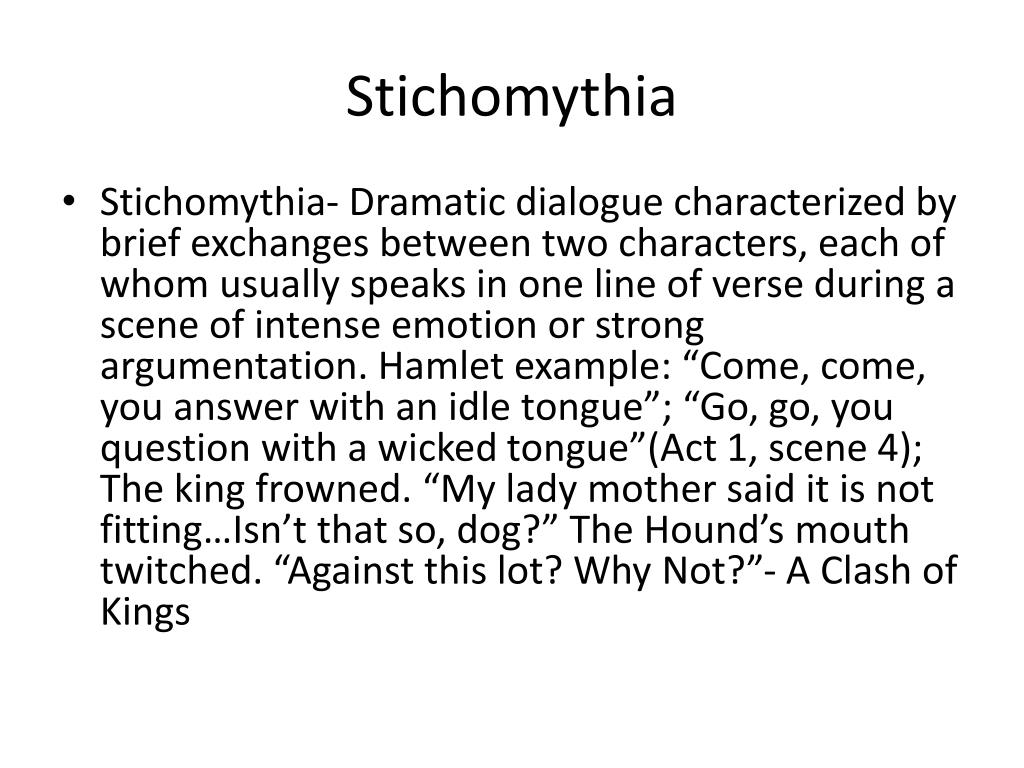
The Odes delivered by the Chorus in Greek tragedy. Stichomythia. The rapid exchange of dialogue, derived from Greek tragedy. Stock character. A character who is immediately
Download Citation | ‚Microstructure‘ in Greek Tragedy: From Bad to Worse—Wrong Guesses in Euripidean Stichomythia (Including a Comparison with Aeschylus and Sophocles): Part I.
Abstract. All three of the great poets of ancient Greek tragedy wrote for an audience that enjoyed displays of rhetoric. Many scenes turn on attempts at persuasion, which
- Part I. Dramatic Representations of Verse Competition
- 7. Antiphonal structure and antithetical thought
- ‚Microstructure‘ in Greek Tragedy: From Bad to Worse
- Ähnliche Suchvorgänge für Stichomythia in greek tragedy
stichomythia, dialogue in alternate lines, a form sometimes used in Classical Greek drama in which two characters alternate speaking single epigrammatic lines of verse. This device, which
Chapter 6: An Introduction to Greek Tragedy
Wikipedia EN. Stichomythia (Greek: στιχομυθία; stikhomuthía) is a technique in verse drama in which sequences of single alternating lines, or half-lines (hemistichomythia) or two-line
Ancient Greek playwrights each had unique styles and approaches to utilising the chorus in their works. There were differences in not only the number of chorus members but
Understanding the whole of a fragment of life involves knowing all these characterising elements. Greek tragedy, conceived on stage as a global expression, is projected to perform all these
Stichomythia was common in ancient Greek tragedies and comedies but is also found in English drama. Here, as an example, is a short passage from Shakespeare’s The Merchant of Venice,
Greek playwrights, such as Aeschylus, Sophocles, and Euripides, utilized stichomythia as a dramatic device to heighten tension and emphasize verbal conflict between characters. These exchanges often occurred during
3 Passages of stichomythia found in Aeschylus have been usefully distinguished ac- cording to their dramatic function under headings such as question and answer, argument, persuasion,
- 2. The ἀντιλαβή and Aristophanes’ Frogs 1198–1248
- Concordia Library: The Tragic Hero in Greek Drama: Structure
- Ähnliche Suchvorgänge für Stichomythia in greek tragedyPoetry Guide: Stichomythia
- Music, Soundscapes and Performance in Greek Tragedy
- Subject specific vocabulary
Part I. Dramatic Representations of Verse Competition
Tragedy has a characteristic structure in which scenes of dialogue alternate with choral songs. This arrangement allows the chorus to comment in its song in a general way on
Ancient Greek drama emerged in the 5th century BC during the Golden Age of Greece, marked by two main types: tragedy and comedy. Tragedies typically involved noble,
Greek tragedies and comedies were performed in outdoor theaters with a circular orchestra space for dancing and a seating area carved into hillsides. Major playwrights
The Greek Theater. —Since, as we have seen, both tragedy and comedy among the Greeks were choral by origin, the center of their theaters was a circular “dancing place”
In Plato’s Republic, when Socrates is describing the imperviousness to fear of the Guardians of his new Republic, he catches himself using rather grand metaphorical terms, and he
Die Stichomythie wird vereinfacht auch Zeilenrede genannt. Sie findet vor allem in der griechischen Tragödie Gebrauch, z. B. im König Ödipus von Sophokles. Les stichomythies
Stichomythia is a technique in drama or poetry, in which alternating lines, or half-lines, are given to alternating characters, voices, or entities.The term originated in the literature of Ancient Greece, and is often applied to the dramas of
„‘Microstructure’ in Greek Tragedy: From Bad to Worse—Wrong Guesses in Euripidean Stichomythia (Including a Comparison with Aeschylus and Sophocles)“ published
Part I. Dramatic Representations of Verse Competition: 1. Stichomythia – Center for Hellenic Studies Dubischar, M. “’Microstructure‘ in Greek Tragedy: From Bad to Worse: Wrong Guesses
Als Stichomythie, auch Zeilenrede, wird die schnelle und zeilenweise Wechselrede zwischen mehreren Figuren in einem Dialog bezeichnet.Das bedeutet, dass die verschiedenen Redner
Stichomythia in Greek Tragedy – Walter Jens: Die Stichomythie in der frühen griechischen Tragödie. (Zetemata, Heft 11.) Pp. 104. Munich: Beck, 1955. Paper, DM. 9.50
According to Aristotle who first defined it using the Greek plays that were available to him, tragedy is “the imitation of an action that is serious and also, as having magnitude, complete in itself.”
The Persians. The Persians, Aeschylus’s earliest surviving tragedy, analyzes this system of divine retribution in the context of the unsuccessful invasion of Greece by the Persian king Xerxes in 480-479 b.c.e.Instead of the
Stichomythia is the form usually employed for rapid exchanges in Greek tragedy. Thus it is the usual alternative, in dialogue scenes, to extended speeches (rhēseis; see speech
Greek Tragedy Greek Tragedy. Aeschylus and Sophocles Aeschylus and Sophocles. Euripides Euripides. Endnote 2006 Endnote 2006. Notes. Notes . 3 On the Tragedian Chaeremon:
Part I brings to attention and analyzes a hitherto undiscovered set-piece of Euripidean stichomythic dialogue. This dialogue occurs most regularly and most powerfully in the
This kind of rhetorical display, characteristic of Greek prose style in late antiquity, has led E. A. Norden to conclude that the principal distinction between antithetical style in Greek and
why strict stichomythia is the predominant form of dialogue in Greek tragedy, or what special effects are achieved by this as compared with a freer form of dialogue; it might, for instance,
In Greek tragedy, a speech or brief scene preceding the entrance of the chorus and the main action of the play, usually spoken by a god or gods. A speech or brief scene that introduces the
- Risse An Den Fingern In Der Nähe Der Nägel: Ursachen, Behandlung
- Popsicles, Tattoo Von Tattly
- Guide :: Anti Cheat For Cs:go
- Mercedes Glk Dachträger – Mercedes Dachträger Befestigung
- Bgh Lässt Berufung Im Bmw-Abgasskandal Zu
- Martin, Gummersbach Im Das Telefonbuch
- Easy Bavette Steak Recipe: How To Make Bavette Steak
- Vorbereitet Für Den Notdienst: Notdienste Gesetzliche Regelung
- Unterschied Samsung S7 Edge Und S10
- Seelauf Ebersberg 2024 – Ebersberger Seelauf