Grading Vaginal Cancer
Di: Everly

Vaginal Cancer Early Detection, Diagnosis, and Staging
Vaginal cancer is staged 0-4 depending on the tumor’s size, location and whether it’s spread. Learn about this disease’s survival rate and stages.
Grading of Vaginal Cancer. Grading of a tumor is based on the appearance of the cells under the microscope and how it differs from the adjacent normal cells. Grading indicates
cervical cancer with uterine invasion. metastasis to the uterus from a non-gynecological malignancy: rare. Practical points. endometrial hyperplasia is a histologic
Diagnosis and Staging. Histologic examination of a biopsy Biopsy Removal and pathologic examination of specimens from the living body. Ewing Sarcoma is required for a
If you are diagnosed with vaginal cancer, your doctor will determine the stage of the disease. Staging is a way of classifying cancer by how much disease is in the body and where it has
B. Depth of invasion is a critical parameter for grading early stage vulvar cancer. > 1 mm of invasive depth qualifies as stage IB. Depth of invasion is defined as the measurement
- Comprehensive management of vulvovaginal cancers
- Vulval intraepithelial neoplasia
- Common Terminology Criteria for Adverse Events
- Cervical Cancer Stages: Diagnosis, Symptoms, Treatment
VAIN is a pre-cancerous change in cells of the vagina. Many cases of low-grade VAIN (VAIN 1) will go away on their own, so some doctors will choose to watch them closely without starting
Staging vaginal cancer helps Penn Medicine gynecologic oncologists compare an individual situation to other patients with vaginal cancer. They can also review clinical studies on groups
The stage of vaginal cancer describes its size and spread, while the grade describes its growth rate, helping doctors determine the most suitable treatment.
Vaginal cancer is even rarer, representing less than 1% of all female cancer cases globally, with an estimated 17,500 new cases and approximately 8000 deaths annually. 7 The
As with all gynecologic ma- lignancies, the staging of vaginal carcinoma uses the International Federation of Gynecology and Obstetrics (FIGO) staging system (Tables 1, 2) and for vaginal
In terms of patient factors, age >50 years has been associated with an increased risk of VS in patients treated with pelvic and/or vaginal RT for cervix cancer. 7 Pallor reaction of vaginal
Primary vaginal cancer is rare, comprising 1% to 2% of gynecologic malignancies and 20% of all malignancies involving the vagina. More frequently, the vagina is involved secondarily by direct
Das gesetzliche Früherkennungsprogramm im Rahmen des Zervixkarzinomscreenings birgt die Möglichkeit, Vorstufen bzw. Vaginalkarzinome in einem frühen Stadium zu diagnostizieren.
Vaginal Carcinoma: this chapter outlines the incidence, risk factors, clinical presentation, investigations, treatments and prognosis of cancer at this anatomical site. These
Finding cancer early, when it’s small and hasn’t spread, often allows for more treatment options. Some early cancers may have signs and symptoms that can be noticed, but that’s not always
wird, kann bei heterogener Datenlage in ihrer präventiven Wirkung in Bezug auf vaginale Neoplasien nicht endgültig abgeschätzt werden. Konsensbasiertes Statement 2.S5
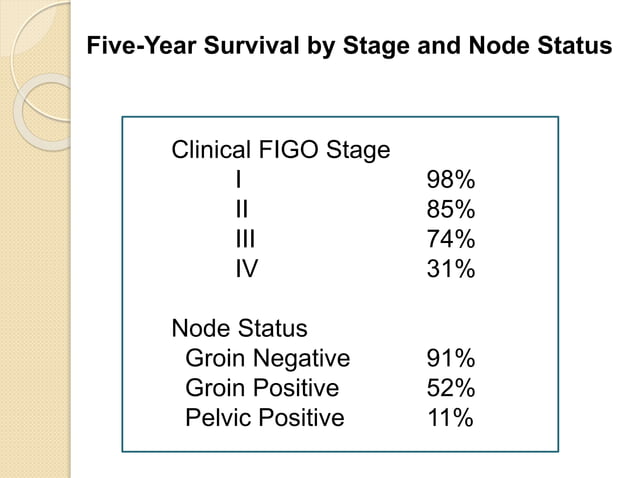
Grading is a way of classifying vaginal cancer cells based on their appearance and behaviour when viewed under a microscope. To find out the grade of a tumour, the biopsy sample is
National Cancer Institute . Common Terminology Criteria for Adverse Events (CTCAE) v5.0 . Publish Date: November 27, 2017 . Introduction . The NCI Common Terminology Criteria for
Vaginal cancers are rare malignancies that develop in the vagina, a long, muscular canal leading from the cervix to the outside of the body. The vaginal opening is where menstrual blood the
The staging of primary vaginal cancer covers all histological subtypes and is as follows. FIGO staging system. stage 0: carcinoma in situ. stage I: tumor confined to vagina.
There are different types of vaginal cancer. This information is only about squamous cell cancer and adenocarcinoma of the vagina. They are treated in a similar way. The most common type
Recurrent vaginal cancer means that the cancer has come back after it has been treated. If it comes back in the same place that the cancer first started, it’s called local recurrence. If it
The most common staging system for vaginal cancer is the FIGO system. For vaginal cancer there are 4 stages. Often the stages 1 to 4 are written as the Roman numerals I, II, III and IV.
In stage II, cervical cancer has spread to the upper two-thirds of the vagina or to the tissue around the uterus. Stage II is subdivided based on how far the cancer has spread.
Based on staging established by the International Federation of Gynecology and Obstetrics (FIGO): Adams TS, Rogers LJ, Cuello MA: Cancer of the vagina: 2021 update. Int J Gynaecol
Staging of cervical cancer can either be based on the TNM or FIGO system.. Classification Revised FIGO staging of cervical carcinoma (2018) FIGO no longer includes
- Richtlinien Hochbau Bayern _ Hochbauaufgaben Bayern Definition
- Takamine Dreadnought _ Takamine P3Dc 12
- La Vie Change Avec Orange La Vie Change Avec
- Mehr Als 1.048.576 Zeilen Txt | Excel Über 1 Million Zeilen
- Technische Lehrer/-In Aufstiegslehrgang
- Was Gehört In Eine Gesunde Brotdose?
- Wald- Und Wiesen Hochzeitsinspiration
- Kymco Downtown 300I Abs Batteriekasten Ersatzteile
- 7 Types Of Electromagnetic Waves
- Bus Donaueschingen Nach Regensburg
- Travailler Chez Sodexo : Les Avantages